

(English below)
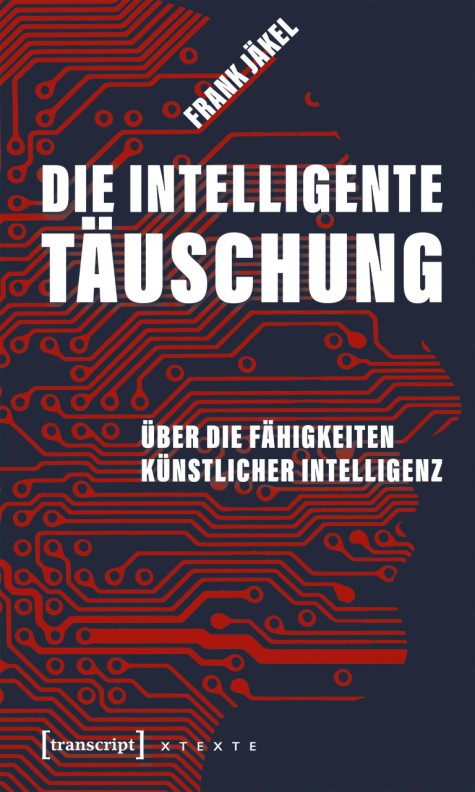
Am 12. August 2025 ist im transcript Verlag Frank Jäkels neues Buch erschienen: „Die intelligente Täuschung: Über die Fähigkeiten Künstlicher Intelligenz“.
Es bietet eine klare, fundierte Einschätzung dessen, was KI tatsächlich kann – und zeigt, warum wir ihre Möglichkeiten oft systematisch überschätzen.
„Wir schreiben Maschinen vorschnell menschliche Intelligenz zu und übersehen so die wahren Chancen und Risiken von KI“, sagt Frank Jäkel.
Das Buch richtet sich an ein breites Publikum und möchte besonders Lehrkräfte darin unterstützen, Kinder auf eine Zukunft vorzubereiten, in der KI unsere Art, Probleme zu lösen, nachhaltig verändert.
Erhältlich als Taschenbuch – und auch kostenlos in einer digitalen Ausgabe. transcript Verlag
<<< >>>
On August 12, 2025, transcript Verlag released Frank Jäkel’s new book, “The Intelligent Deception: Understanding the Capabilities of Artificial Intelligence.”
It offers a clear-eyed look at what AI can – and cannot – do, revealing why we so often overestimate its potential.
“We’re too quick to ascribe human intelligence to machines, and in doing so, we miss the real opportunities and risks of AI,” says Jäkel.
Written for a broad audience, the book aims especially to support educators in preparing students for a future where AI will reshape how we approach problem-solving.
Available in paperback and as a free digital edition. transcript Verlag
(The book is only available in German.)
Humans constantly search for and use information to solve a wide range of problems related to survival, social interactions, and learning. While it is clear that curiosity and the drive for knowledge occupies a central role in defining what being human means to ourselves, where does this desire to know the unknown come from? What is its purpose? And how does it operate? These are some of the core questions this book seeks to answer by showcasing new and exciting research on human information-seeking. The volume brings together perspectives from leading researchers at the cutting edge of the cognitive sciences, working on human brains and behavior within psychology, computer science, and neuroscience. These vital connections between disciplines will continue to lead to further breakthroughs in our understanding of human cognition.
Available as paperback, hardback and digital edition. Cambridge University Press
(The book is only available in English.)


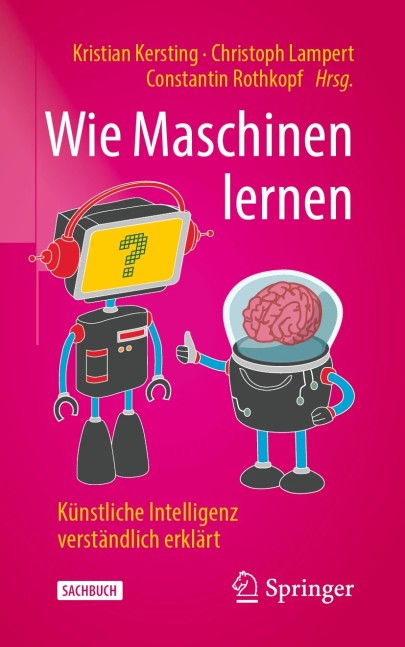

Am 15. Oktober 2019 ist im Springer-Verlag das Buch „Wie Maschinen lernen: Künstliche Intelligenz verständlich erklärt“ erschienen, herausgegeben von Kristian Kersting, Christoph Lampert und Constantin Rothkopf.
Es bietet eine anschauliche Einführung in die Themen Künstliche Intelligenz (KI) und Maschinelles Lernen (ML) – ganz ohne komplizierte Formeln. Vorgestellt werden zentrale Begriffe wie Daten und Algorithmen ebenso wie grundlegende Verfahren wie Regressionen und Clusteranalysen. Gleichzeitig verortet das Buch KI und ML im gesellschaftlichen Kontext und zeigt auf, welche Chancen und Risiken mit ihnen verbunden sind.
Das Buch richtet sich an ein breites Publikum – von Schülerinnen und Schülern bis hin zu Entscheidungstragenden – und möchte Grundlagenwissen über KI zugänglich machen.
Erhältlich als Taschenbuch und als digitale Edition. Springer Verlag
<<< >>>
On October 15, 2019, Springer Verlag released the book “How Machines Learn: Artificial Intelligence Explained in Simple Terms,” edited by Kristian Kersting, Christoph Lampert, and Constantin Rothkopf.
It offers a clear introduction to the topics of artificial intelligence (AI) and machine learning (ML) – without any complicated formulas. Key terms such as data and algorithms are presented, as well as basic methods such as regressions and cluster analyses. At the same time, the book places AI and ML in a social context and highlights the opportunities and risks associated with them.
The book is aimed at a broad audience – from schoolchildren to decision-makers – and aims to make basic knowledge about AI accessible.
Available as a paperback and digital edition. Springer Verlag
(The book is only available in German.)