
For designing our network, we consider the transport and spatial distribution of oxygen and nutrients in cell aggregates. Furthermore, we ensure that the oxygen and nutrient supply can be determined and controlled. Lastly, we characterise their influence on the development and long-term maintenance of organ-like human cell aggregates. By combining engineering with biological principles, and synthetic with biological materials, we aim to create three-dimensional hybrid tissues ex vivo.
Approach
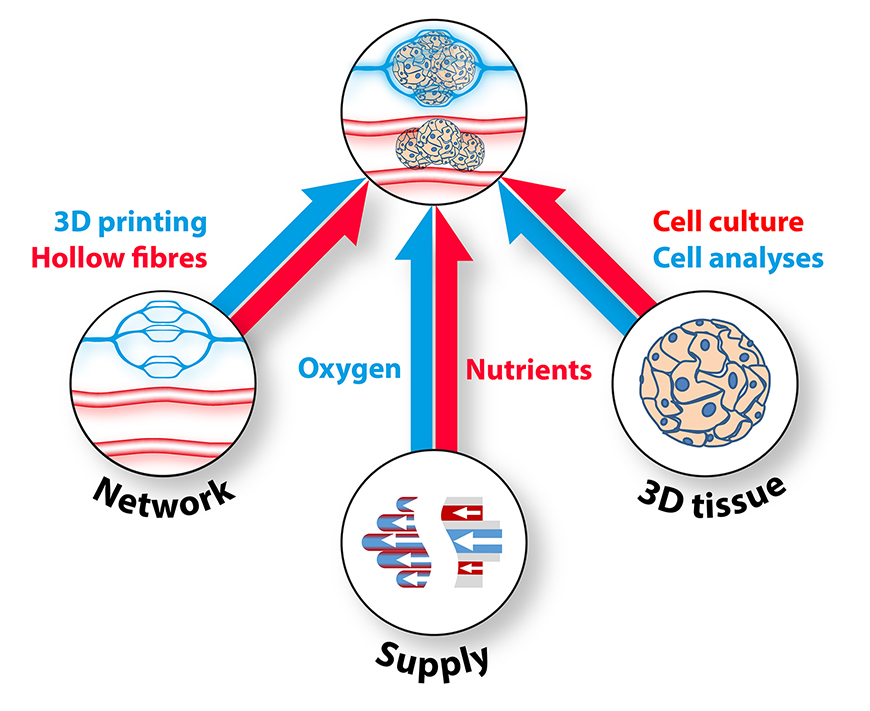
We are pursuing an innovative and comprehensive research approach: To address the overarching question of how an artificial network to supply human organ-like cell aggregates should look like and can be created, we focus on three components: The network itself, 3D tissue, and its supply.
Main challenges
Network
Design and simulation
Research on the optimal design of tree-like fluidic networks has a long history. However, problems of transport within a network coupled to transport in the external space are still largely unsolved.
Flow characterisation
We deal with several challenges: characterising flow in geometrically complex networks, combining flow measurements with the visualisation of oxygen supply, integrating light sheet microscopy and flow measurements, and understanding the relationship between flow and tissue supply.
Jeanette Hussong
Network generated by 2-photon polymerisation
Merging design requirements for the artificial supply network with manufacturing resolution and speed is challenging. Furthermore, post-processing of the filigree, highly-branched supply network as well as its handling and transport are demanding.
Steffen Hardt, Andreas Blaeser
Network made of hollow fibres in paper
Passive transport in microfluidic papers can in principle be used to provide cells with nutrients and oxygen, but is not sufficient to supply tissue of several mm diameter over periods of weeks. Our challenge is to integrate hollow fibres into hybrid papers for the long-term supply of larger cell aggregates.
Supply
Oxygen input (external and internal)
Research problems are the external oxygen presaturation of the nutrient medium. How can higher oxygen pressures be used for volume-minimal saturators? What are the kinetics of permeation and mass transfer of oxygen for this system? Is there an overpotential or undesirable side reactions in the nutrient medium during internal generation (electrolysis)?
Fluidic device
Our project requires the design and construction of a fluidic device that meets several demands: gas- and liquid-tight connections between different materials, non-destructive, light microscopic analyses of cells, connection to oxygen input, and integration of networks of different development stages.
3D tissue (cell culture and cell analyses)
Microgels
Microgels are composed of cross-linked polymer chains swollen with a solvent. Because of their unique properties, such as deformability, surface morphology or roughness, they are increasingly used for biomedical applications. Microgels are promising components to line the interior surface of the branchy network as coupling agents for endothelial cells.
Assembly of cell-hydrogel formulations
Our challenge is to identify and develop suitable hydrogels to be combined with cells for the creation of 3D tissue. Moreover, we develop methods for the accurate positioning of cell-hydrogel formulations.
Cell aggregates and endothelialisation
Challenges we face are the development of pre-organised cell aggregates from stem cells and the endothelialisation of artificial network walls.
3D microscopy
The major challenges are to establish sample preparation procedures taking into consideration the hybrid nature of the organ-like large cellular systems to be created and the fitting microscopical approaches based on the light sheet microscopy technique and enabling subsequent image analysis.
3D image analysis and modelling
Main challenges are the automatic 3D reconstruction, calibration of cell models, and the modelling of the growth of cell aggregates as a function of network properties.