Metal Energy Hub opens at TU Darmstadt
Metals as Energy Storage: EU and state of Hesse fund project with three million Euros
2025/11/19 by MEH/mih
How can renewable energy be stored safely and climate-neutrally over long periods of time? Researchers at TU Darmstadt are now addressing this and other key questions of the future in the newly established Metal Energy Hub (MEH) – thereby continuing the work initiated in Clean Circles.
-
![]()
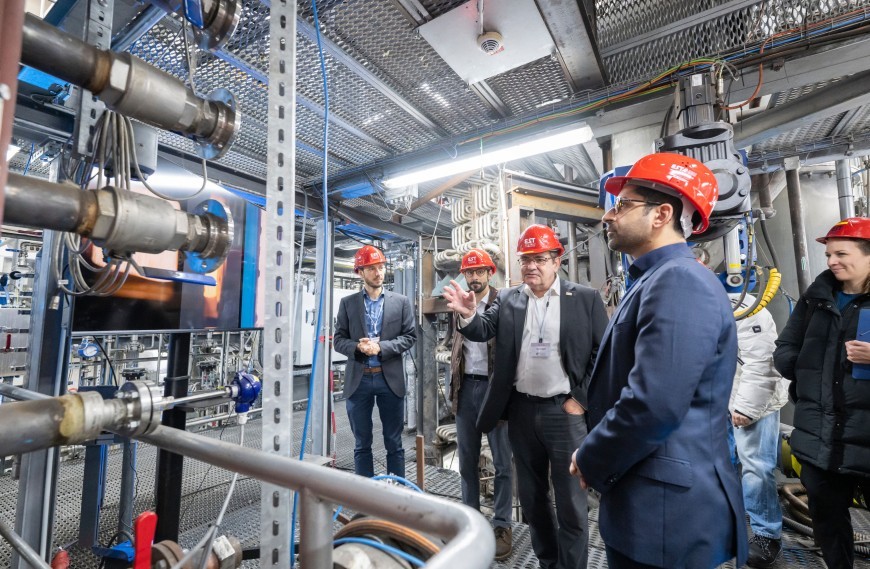
Professor Bernd Epple (centre) from the Department of Energy Systems and Energy Technology explains the pilot plant on the Lichtwiese campus to Hessian Minister of Economic Affairs Kaweh Mansoori (right). -
![]()
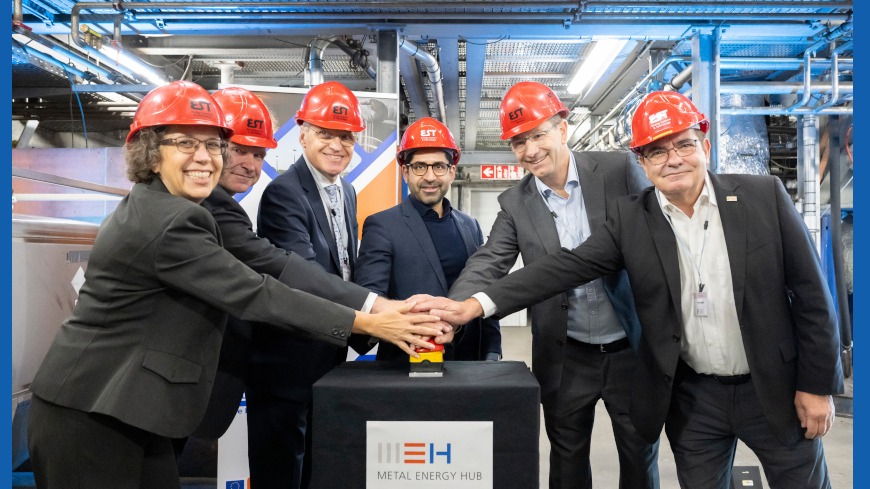
Start of the pilot plant: from left to right, Professor Michèle Knodt, Professor Andreas Dreizler, Professor Thomas Walther (Vice President of TU Darmstadt), Minister of Economic Affairs Kaweh Mansoori, Professor Christian Hasse (project coordinator), and Professor Bernd Epple. -
![]()
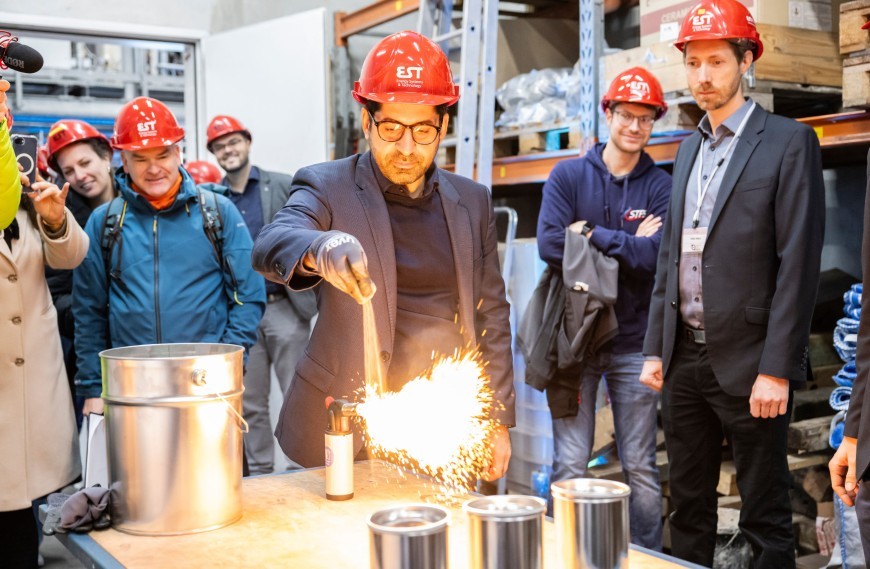
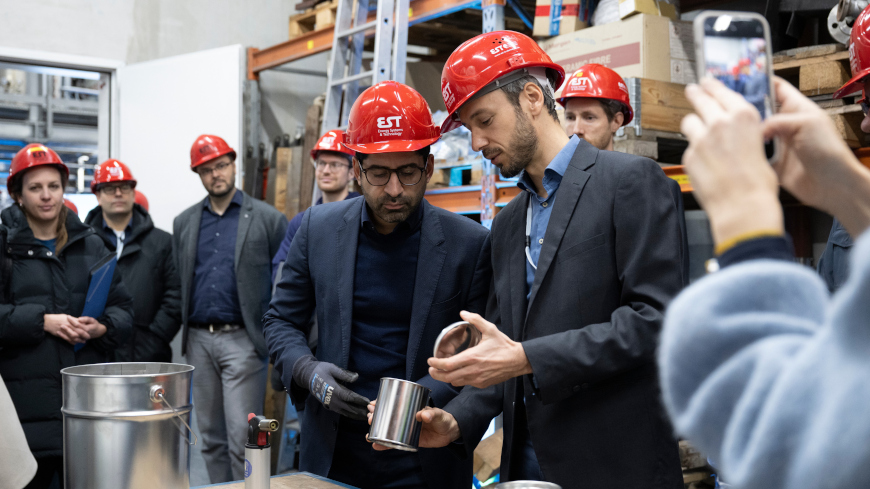
Demonstration of iron powder combustion for Kaweh Mansoori. -
![]()
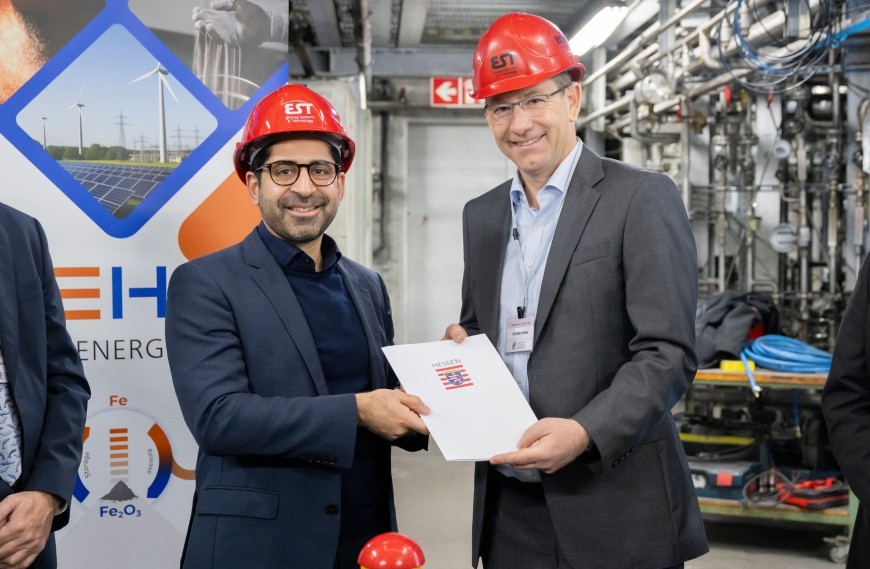
The Hessian Minister of Economic Affairs Kaweh Mansoori presents the funding notification to Professor Christian Hasse, coordinator of the Metal Energy Hub project. -
![]()
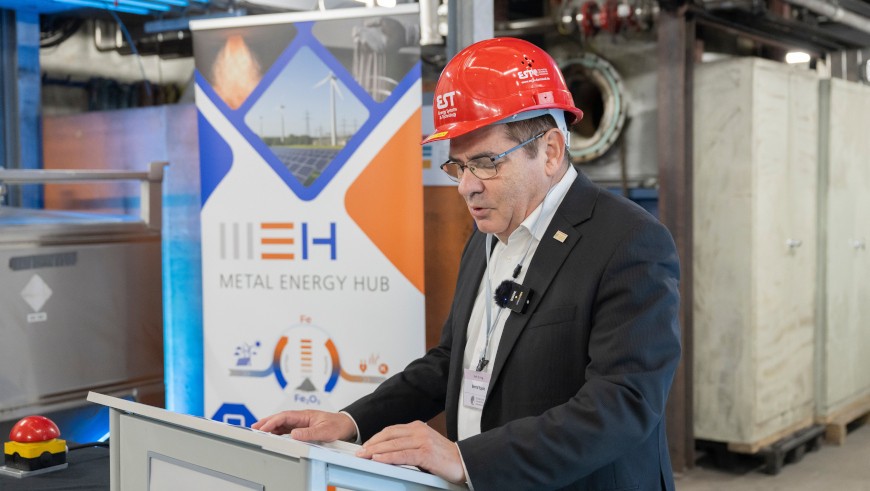
Professor Bernd Epple speaking at the opening of the pilot plant. -
![]()
Guided tour of the Metal Energy Hub pilot plant with Minister Kaweh Mansoori (left) and Managing Director Dr.-Ing. Marius Schmidt (right). -
![]()
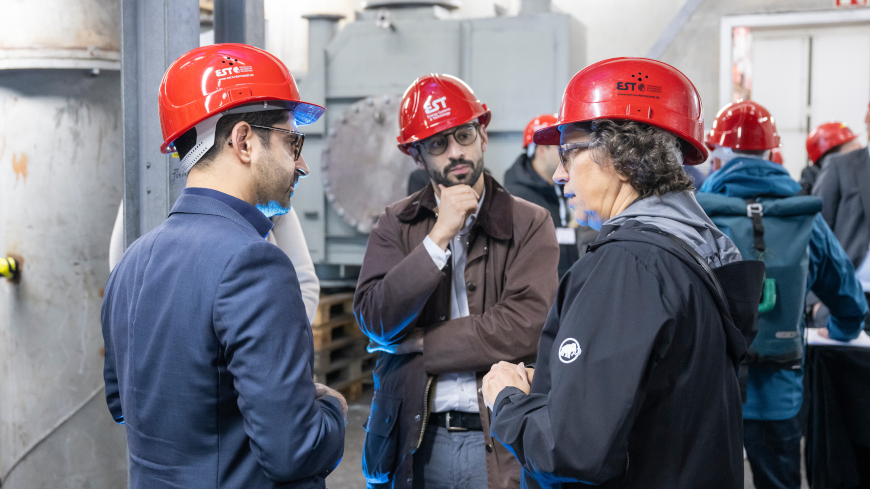
Kaweh Mansoori (left) in conversation with MdL Bijan Kaffenberger (centre) and Professor Michèle Knodt (right). -
![]()
Kaweh Mansoori: “The citizens … the companies in this state wish you all success, and I believe the future is being written here.”


- Go to picture 1
- Go to picture 2
- Go to picture 3
- Go to picture 4
- Go to picture 5
- Go to picture 6
- Go to picture 7
- Go to picture 8
To advance environmentally friendly energy storage solutions, TU Darmstadt is consolidating its research activities on metallic energy carriers in the newly founded Metal Energy Hub. The centre, which was inaugurated in November on the Lichtwiese campus, receives three million euros in funding from the State of Hessen and the European Union. Hessian Minister of Economic Affairs Kaweh Mansoori visited the university to present the funding notification and celebrate the start of a new pilot plant.
At the Metal Energy Hub, researchers aim to develop metal-based energy storage technologies as an innovative solution to Germany’s long-duration storage challenge. This challenge arises because renewable energy systems require massive storage capacities, while existing technologies such as batteries and pumped-storage plants are insufficient for seasonal storage over extended periods. The Darmstadt research teams therefore focus on metals as chemical energy carriers.
The new pilot plant—unique among universities—enables the combustion of several hundred kilograms of iron powder per hour, releasing one megawatt of thermal power and reaching a semi-industrial scale. Iron powder offers the advantages of safe, loss-free long-term storage and straightforward transport. Its combustion generates CO2-free heat, which can be used for electricity production in power plants or for industrial and district heating. The technology allows former coal power plants to be converted into CO2-free iron power plants, reusing existing infrastructure and accelerating the energy transition.

A key role in the energy transition?
“Especially in highly relevant areas such as the energy transition, it is essential to advance technology transfer in parallel to fundamental research,” says Professor Thomas Walther, Vice President for Innovation and International Affairs at TU Darmstadt. “The Metal Energy Hub is a perfect example of how strong research and active exchange go hand in hand, enabling innovations with real impact.”
Iron is one of humanity’s oldest materials and could now play a key role in global climate-neutral energy supply, explains project coordinator Professor Christian Hasse from the Department for Simulation of reactive Thermo-Fluid Systems (STFS): “We build on successful collaborations with our partners—such as the Karlsruhe Institute of Technology—within the Clean Circles project. With the Metal Energy Hub, we are now creating a platform to bring metallic energy carriers into industrial application as a scalable solution for renewable energy storage and transport.”
Technology and Transfer Center
Technology manager Marius Schmidt emphasizes that the MEH aims to demonstrate that metallic energy carriers are not only functional in the laboratory but also in industrial environments. “The one-megawatt pilot plant is a decisive step in this direction. Through our partner network, we bring together research, industry, and policymakers—so that technological innovations quickly become market-ready solutions,” he says. “It is not just about a new technology, but about intelligently transforming existing infrastructure in Germany instead of writing it off.”
In addition to STFS, the involved research groups include Institute for Reactive Flows and Diagnostics (RSM; Professor Andreas Dreizler), Energy Systems and Technology (EST; Professor Bernd Epple), and the Institute for Technical Thermodynamics (TTD; Professor Peter Stephan), as well as Professor Michèle Knodt from the Institute of Political Science. Together, the team aims to conduct research from burner concepts to semi-industrial scale, drive technological development, and analyze metallic energy carriers and associated business models from system and socio-economic perspectives. Through the partner network, the team intends to accelerate market introduction and prepare a future spin-off.
Iron as a Key Technology for the Energy Transition
Making surplus renewable energy from summer available for use in winter is possible with iron powder as a CO2-free energy storage medium. The concept is as simple as it is ingenious: iron powder is combusted, releasing energy in the form of heat—without CO2 emissions. This process produces iron oxide, which can be converted back into iron using green hydrogen or electrolysis. The cycle can be repeated indefinitely and enables long-term energy storage that, unlike batteries, has no self-discharge.