Linguistic and Literary Computing
Master of Arts; tuition language: German and English
The following English language content is for information purposes only. The legally binding content can be found on the corresponding German website.
Description
The bilingual (German and English) Master of Arts programme in Linguistic and Literary Computing acquaints the students with digital resources, infrastructures and methods in regard to philology.
The two main areas of specialisation are Computer Philology and Corpus and Computer-based Linguistics.
Additionally, computer programming and an English language course (levels C1 – C2 GER) are part of the programme.
Module Handbook (opens in new tab)
Study Regulations with Semester Course and Examination Schedule
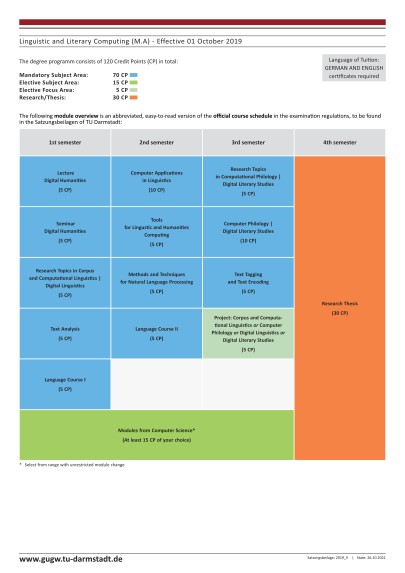

Structure of the degree program
The degree programme is divided into five topic areas:
•Digital Humanities: Introduction
•Linguistic and Literary Computing
•Corpus and Computer Linguistics
•Computer Philology
•English Language skills
•Computer Science
Information on the areas of specialisation:
Computer Philology looks into questions of media-based and digital rendering of texts from literary and cultural contexts. This regards, among others, the medial aspects of texts and their digital rendering in editions, and computer-aided search in larger texts.
Corpus and Computer-based Linguistics have at their core the computer-aided analysis of linguistic data bases, the so-called corpora. Students learn the systematic and reproductable analysis of linguistic questions.
The programme is completed with a Master’s Thesis.
| Semesters | 4 |
| Language | German and English. Please be aware that scientific literature is be read and edited also in English or other foreign languages. |
| Start of studies | Winter semester recommended; summer semester possible without study guarantee |
| Internship | Completing several internships throughout the programme is recommended particularly regarding professional orientation. |
| Admission requirements |
1. A degree B.A. Digital Philology or J.B.A. Digital Philology of TU Darmstadt (reference programme) or an equivalent degree. 2. English at C1 (GER) level. 3. additional requirements: Study regulations Competences description. 4. Formal and language requirements for applicants with international qualifications; early application deadlines for applicants with international qualifications. See also: General information on applying to a master's degree programme. |
| Admission procedure | Provided that the admission requirements (entrance examination) are met, there are no numerical admission restrictions. |
| Application |
Application portal and application deadlines How and when to provide the certification of the bachelor's degree Formal and language requirements for applicants with international qualifications Step-by-step guide to applying |
| Good to know |
Costs and budget Pre-Courses, orientation week, getting started Preparatory courses for international students Study Abroad Part-time studies Doctoral Studies TU Darmstadt Career Service Alumni careers |