The following English language content is for information purposes only. The legally binding content can be found on the corresponding German website.
The Lehramt an Gymnasien (Teaching at Secondary Schools) programme prepares the students for the teaching profession at Secondary Schools from grades 5 to 13. It consists of two subjects, and additionally the ‚Bildungswissenschaften‘ (educational sciences) and the ‚MINT-orientierter interdisziplinärer Vernetzungsbereich‘ (MINT = STEM). With an in-company internship (called ‚Betriebspraktikum‘) as well as Practical Phases in school (‚Grundpraktikum‘ and ‚Praxissemester‘) the programme is quite practice-oriented.
Additionally, complementary studies for a third subject (‚Ergänzungsstudium Lehramt‘) are possible.
The courses are taught in German.
Degree Programme Teaching at Secondary Schools (Gymnasium). To enlarge / show pdf please click on the picture.
Description
Subject Studies The subject Geschichte addresses the research and interpretation of the past. This is carried out by interpreting historical sources using specific methods. In this context, the programme is divided into the four components of historical studies (Ancient History, Medieval History, Recent History, History of Technology).
Subject-related Didactics Throughout several semesters, the students are continuously taught the methodological fundamentals of good History lessons in the the modules of Subject-related Didactics. These skills are directly applied in the Practical Semester and are enhanced throughout additional methodological components of the programme.
Grundwissenschaften (Fundamental Studies). To enlarge / show pdf please click on the picture.
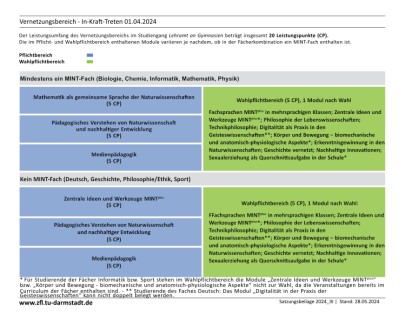
The Vernetzungsbereich is a joint offer of the subjects and the Bildungswissenschaften (educational sciences), which is available to students depending on their subject combination.
The Vernetzungsbereich combines subjects from the natural, engineering and social sciences. The Elective and Mandatory Area of the Vernetzungsbereich vary depending on the choice of major in the degree programme (at least one STEM-major or no STEM-major).
Vernetzungsbereich. To enlarge / show pdf please click on the picture.
Practical training (praktische Ausbildung) as part of the study program consists of a basic internship (‚Grundpraktikum‘) in the first half and a practical semester (‚Praxissemester‘) in the second half of the respective study program. The focus of the basic internship/‘Grundpraktikum‘ is the reflection of one's own suitability for the profession as a teacher in the respective teaching profession. The focus of the internship semester/‘Praxissemester‘ is in particular the reflection of pedagogical action on the basis of the knowledge acquired and deepened during the course of study.
Latin: Proof of Latin language skills (Latinum or equivalent) has to be submitted by the second half of the programme at the latest for seminar enrolment.
For a successful completion of the Teaching at Secondary Schools (Gymnasium) degree programme, the students need to fulfill the following requirements:
an in-company internship of a minimum duration of eight weeks in a production, processing, trade, or service company. It must be proven at the latest when registering for the First State Examination. The competent institution is the Hessische Lehrkräfteakademie (state school board) in Darmstadt
Additional Practical Training consisting of the basic internship (‚Grundpraktikum‘) and the practical semester (‚Praxissemester‘); see above.
For enrolment in the complementary teacher training programme, in particular you need to already have a First State Examination or an equivalent qualification such as Master of Education or you must be currently enrolled in a teacher training course (teaching profession at secondary schools, Bachelor of Education, Master of Education).
Teachers at Secondary Schools do not only teach their subjects but work within a greater pedagogical and organisational framework. They find positions not only at grammar schools (“Gymnasien”), but in different sectors of the widespread school system.
Valid statements on the future career perspectives are not easy to be made since they depend on a variety of factors, for example the range of subjects a teacher is able to teach. Other factors include the overall demographic development, political decisions and administrative regulations.
We would like to customise the information and usability of this website to your preferences and needs.
To this end, we use so-called cookies. Please choose which cookies you would like to enable when visiting our webpages.
Some of these cookies are required to load and correctly display this website on your device.
These are strictly necessary or essential cookies and cannot be deselected.
The preferences cookie saves your language setting, while the statistics cookie regulates
how the open-source statistical software “Matomo” analyses your visits to and activities on our website.
For more information about cookies we use, please refer to our
privacy policy.