Biomolecular Engineering – Molekulare Biotechnologie
Bachelor of Science; tuition language: German
The following English language content is for information purposes only. The legally binding content can be found on the corresponding German website.
Description
Biomolecular Engineering is an interdisciplinary field of science. It has assumed a central role in the field of molecular biosciences as it transfers theoretical knowledge of chemical and biological processes into practice using engineering principles. In this context, new chemical methods, techniques, and syntheses are developed in order to study biological processes in molecular detail. Furthermore, molecular-biological procedures are implemented in order to design biomolecules and to change biological systems selectively.
The Bachelor’s programme Biomolecular Engineering – Molekulare Biotechnologie at the Technical University of Darmstadt is a joint course of study offered by the Departments of Chemistry and Biology. It comprises, in particular, the essential methods and skills of modern general, organic, and physical chemistry as well as of the molecular biosciences. The design of molecules and microorganisms to be utilised in the field of bioengineering is in the focus of the programme.
General note: With the Bachelor of Science degree, students acquire a first degree qualifying them for a profession. However, at the Technical University of Darmstadt the Master of Science is the standard degree. Therefore it is recommended that students complete a Master's programme.
Module Handbook (opens in new tab)
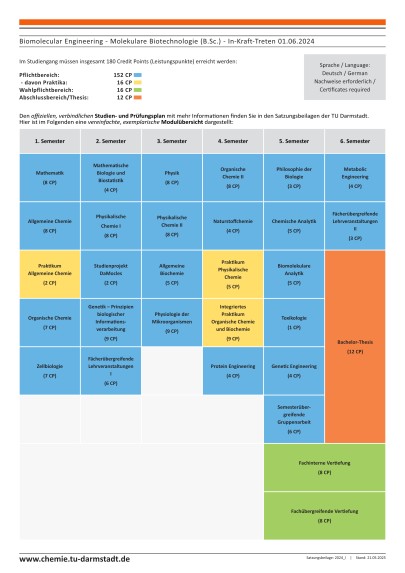
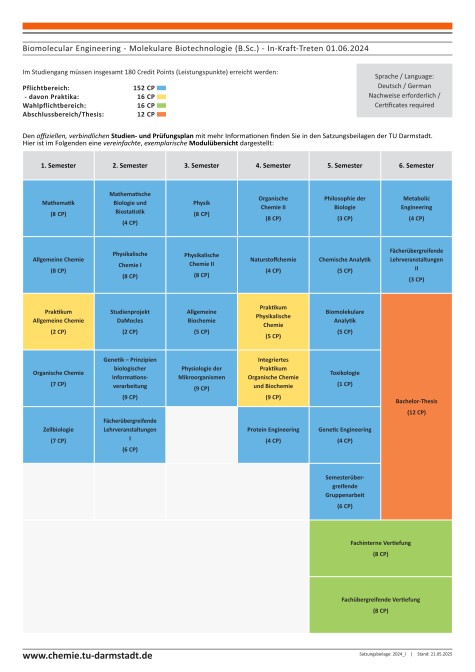
Study Regulations with Semester Course and Examination Schedule
At first hand: A student's perspective
Is the programme right for you? Find out!
Come and see, touch and feel, meet and greet:
hobit: Hochschul- und Berufsinformationstage in Darmstadt (orientation event; January and May)
University visits, labs, internships, and more
Or online:
Online Self-Assessment for selecting a course of study
Kann ich MINT?
For listeners:
Perspectives on careers:
Career guidings with the #studentsofTUdarmstadt
TU Darmstadt Career Service
| Semesters | 6 |
| Language | German. Individual courses can be offered in English. |
| Start of studies | Winter semester |
| Internship | Internships within the study programme (see semester course schedule) |
| Admission procedure | Open / unrestricted degree programme without special procedures: no restriction in terms of numbers or otherwise |
| Application |
Application portal and application deadlines Formal and language requirements for applicants with international qualifications |
| Good to know |
Costs and budget Pre-Courses, orientation week, getting started Preparatory courses for international students Minimum requirements by the end of the second semester Study Abroad Part-time studies: no |